Headless CMS and Jamstack: A Faster, More Flexible Way to Build Websites
Traditional monolithic CMS platforms couple content management directly to page rendering — a decision that made sense a decade ago and creates real limitations today.
What Headless Actually Means
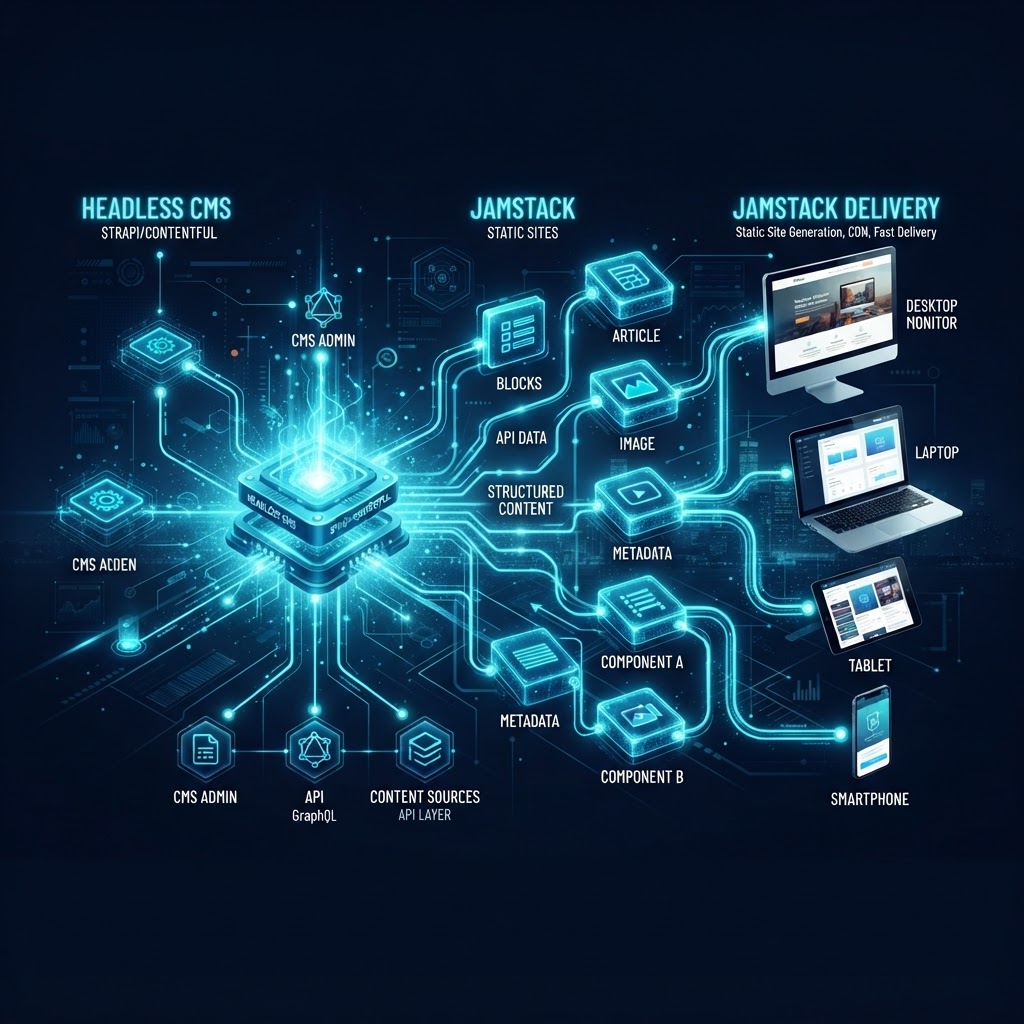
A headless CMS stores and serves content through an API, completely decoupled from how that content is displayed. Your frontend — React, or any other framework — pulls content from the API and renders it however performance and design require.
Why This Matters for Performance
Decoupled architecture (the "Jamstack" approach) lets pages be pre-built or served from fast edge caches, rather than generating markup on every request from a database-coupled backend. The result is consistently faster load times and better Core Web Vitals scores.
Security Benefits Beyond Speed
A traditional CMS with a public-facing admin panel is a constant attack target. Headless architectures typically expose a much smaller, more controlled API surface — fewer places for an attacker to probe.
Flexibility for Multi-Channel Content
The same content stored once can power a website, a mobile app, and even in-app content — without duplicating data entry across systems.
When Headless Isn't Worth the Complexity
For a simple brochure site with infrequent updates, a traditional CMS may genuinely be simpler to manage. Headless architecture earns its complexity when you need speed, scale, or multi-channel content reuse.
We architect custom web platforms using headless and Jamstack patterns exactly where the performance and flexibility gains justify it.
About the Author
Jotunheims Engineering Team
Full-stack engineers building modern, high-performance sitios web and content platforms.